
Pinball is one of those rare objects that has stood the test of time without losing its appeal. Behind its flashing lights, colourful artwork and iconic steel ball lies a story that began long before the advent of arcades.
The history of the pinball machine began far from the neon lights and screens. Its origins can be traced back to a parlour game that emerged in 18th-century France called “bagatelle”. On a sloping tray pierced with holes and dotted with skittles, the player propels a marble using a miniature cue. The principle is simple, but it already captures the essence of the pinball we know and love: a blend of skill, chance and suspense.
When the game crosses the Atlantic, it finds fertile ground. In the early 20th century, American manufacturers gradually transformed this aristocratic pastime into a form of entertainment that would be accessible to the masses. The real turning point came in 1931 with the arrival of the first mechanical coin-operated pinball machines. In an America gripped by the Great Depression, these machines offered a few minutes’ escape for just a few cents. One of them, called “Baffle Ball” and designed by Gottlieb, made gaming history. The concept is simple: shoot a ball and try to score as many points as possible. At that time, the were no flippers the player could use to control the ball’s trajectory. Chance reigned supreme.
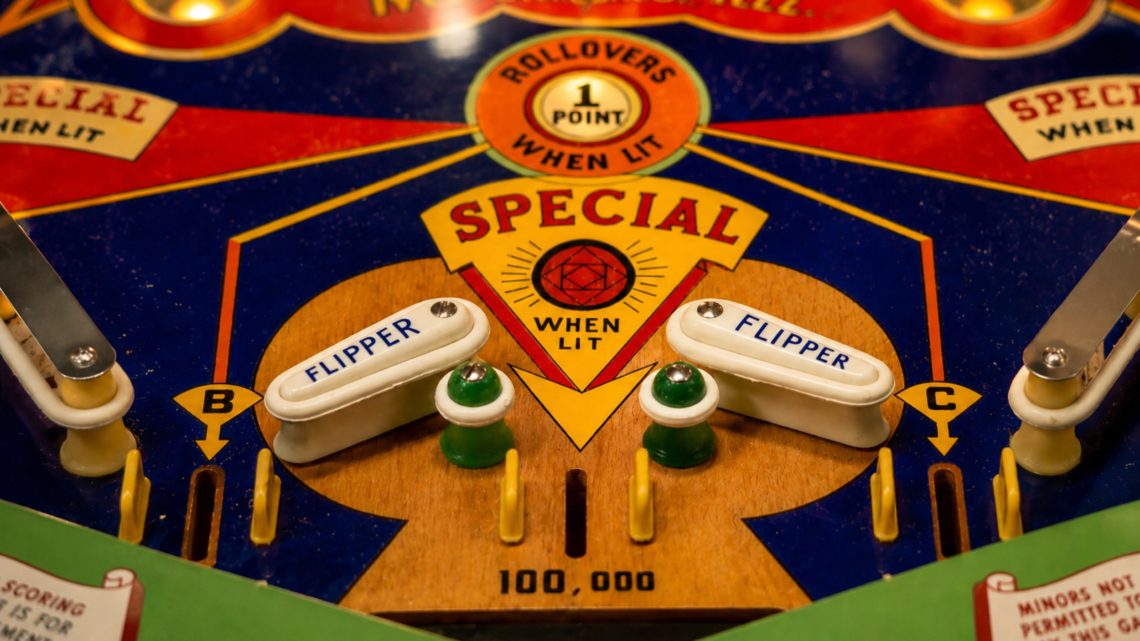
But the pinball machine as we know it today was first invented in 1947. That was also the year the famous electric drums first appeared. Nowadays, players no longer simply watch the ball; they interact with it. Every move is a decision; every bounce an opportunity. Chance gives way to skill, transforming the pinball machine into an interactive experience ahead of its time.
The following decades saw the dawn of the game’s golden age. In bars, seaside resorts and amusement arcades, the machines have become attractions in their own right. Their cabinets are filled with bright colours and references to cinema, space exploration, sport and music. The pinball machine absorbs the dreams of its era and recreates them in the form of flashing lights and improbable pathways.
In many ways, it serves as a wonderful cultural mirror. Every generation projects its heroes, fantasies and stories onto the game. The cabinets capture the spirit of 1950s America, the technological optimism of the 1960s and the excesses of 1980s pop culture. Spanning graphic design, mechanical engineering and popular culture, the pinball machine occupies a unique place in the history of objects.
Yet the advent of video games seemed to have spelled its demise. From the 1990s onwards, the machines gradually disappeared from cafés and arcades. But the pinball machine has a rare quality: it has stood the test of time. For several years now, it has been making a remarkable comeback. Collectors, designers and enthusiasts are restoring historic models, whilst new manufacturers are devising ever more sophisticated machines. Perhaps because, in this digital age, the pinball machine reminds us of the joy of a hands-on gaming experience. Here, nothing is virtual. The ball is real, every movement counts, the machine reacts. Each game is a blend of mechanics, chance and intuition.
More than just a game – the pinball machine has become an icon. That of an inventive popular culture, capable of reinventing itself without ever losing its sparkle. Like a tiny steel ball set rolling over a century ago, which continues, even today, to bounce through the generations.


