
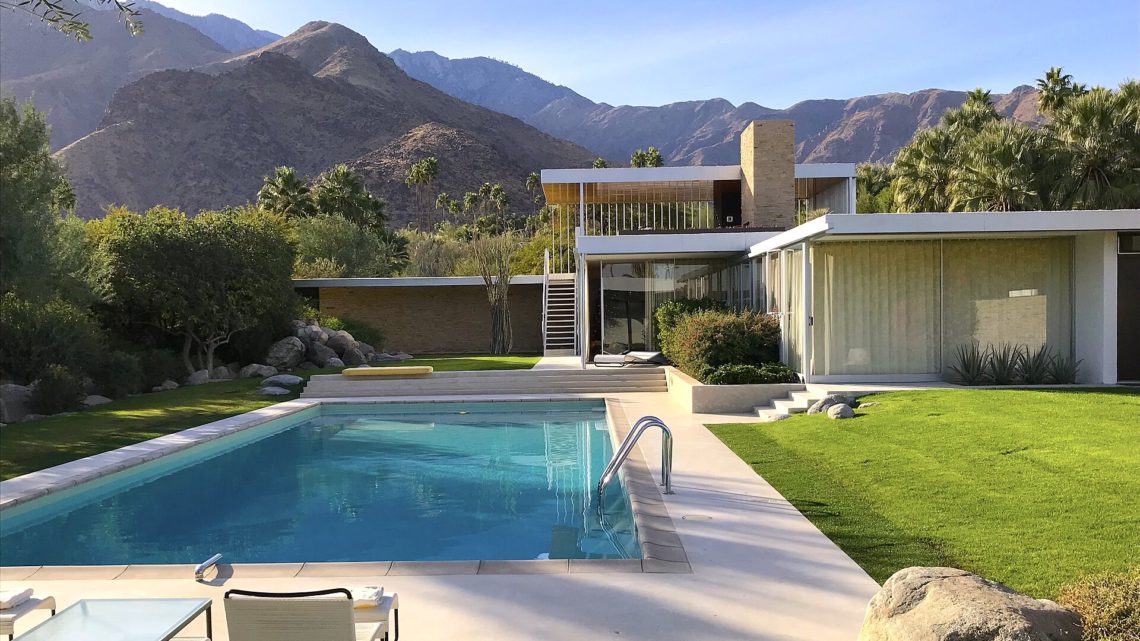
During the post-war years, the California desert town of Palm Springs established itself as one of the most distinctive centres of the Mid-Century Modern style. Between the 40s and the 70s, this sun-drenched enclave became something of an open-air laboratory, where a generation of architects explored a new style of living that blended international modernism with the constraints of the desert environment.
Context plays a key role in this story: located just a few hours’ drive from Los Angeles, the town of Palm Springs attracted a Hollywood clientele in search of the quiet life, and a certain art de vivre. Its arid, unchanging climate required precise solutions: filtering sunlight without creating darkness, and opening up spaces while keeping heat at bay. The architecture had to adapt as a result, favouring clear lines and volumes that spread horizontally, with low roofs that anchored the buildings within the landscape.
This process of adaptation produced a style known as Desert Modernism. The houses cease to exist as independent objects, instead becoming open-concept structures designed to engage in constant dialogue with their environment. Floor-to-ceiling windows, open-plan design, shaded terraces, and materials such as glass, steel and concrete that capture and diffuse light: all these elements come together to create a continuity between interior and exterior. The desert is no longer a backdrop, but a component in the design.
This mindset extends into the ways homes are used: spaces flow outwards towards terraces and swimming pools. As such, the strictness of form aligns with the hedonistic vision of a home: in Palm Springs, the architecture fosters a lifestyle defined by the climate, leisure and comfort. Rather than simply a functional space, the house becomes a place of experiences.
Several noteworthy figures helped shape this landscape, and Albert Frey was among those who laid its foundations. Having trained in Europe under Le Corbusier, he adapted modernism to the desert with a sense of pragmatism. Set against the desert rock, his Frey House II embodies this approach: minimalist architecture that acts as an extension of its surroundings.
Richard Neutra, who moved to California in the 1920s, developed a more
expansive vision. With his 1946 Kaufmann House, he proposed a space based on
transparency and horizontality; the home becomes an apparatus, organised around
the landscape and lifestyle. This house’s legacy also stems from its imagery;
in 1970, photographer Slim Aarons shot one
of his most famous compositions, Poolside
Gossip, at the Kaufmann House.
This perfectly curated scene depicts two women chatting around a swimming pool,
while in the background the house cuts into the mountain landscape, bathed in
clean light. This series of images was highly influential in fixing the idea of
Palm Springs in the public imagination.
Through the eyes of Slim Aarons, desert modernism is depicted from its social
and hedonistic perspectives, associated with a certain idea of leisure,
discreet luxury and carefree living. The Kaufmann House thereby became not only
an architectural benchmark, but a visual icon that embodied this era’s unique
art de vivre.
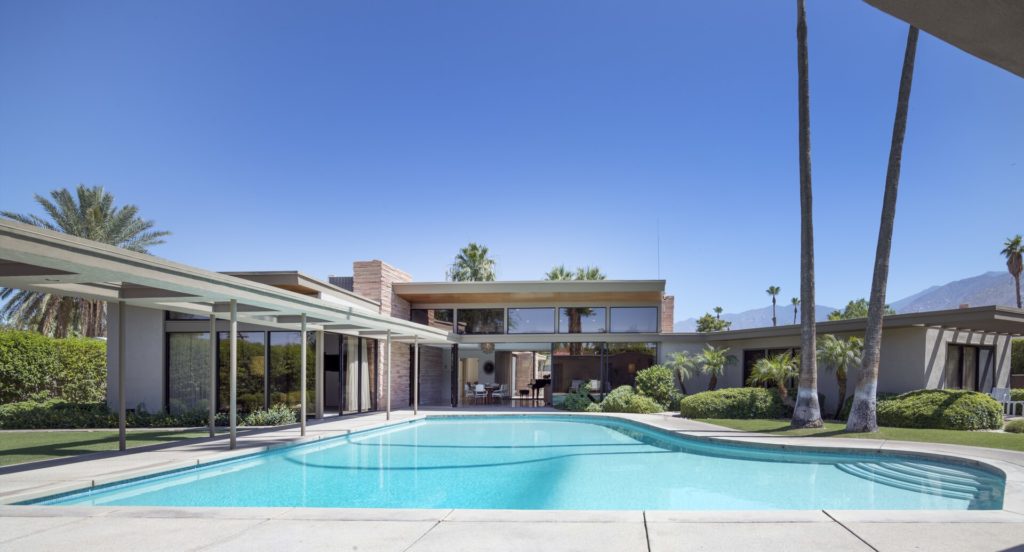
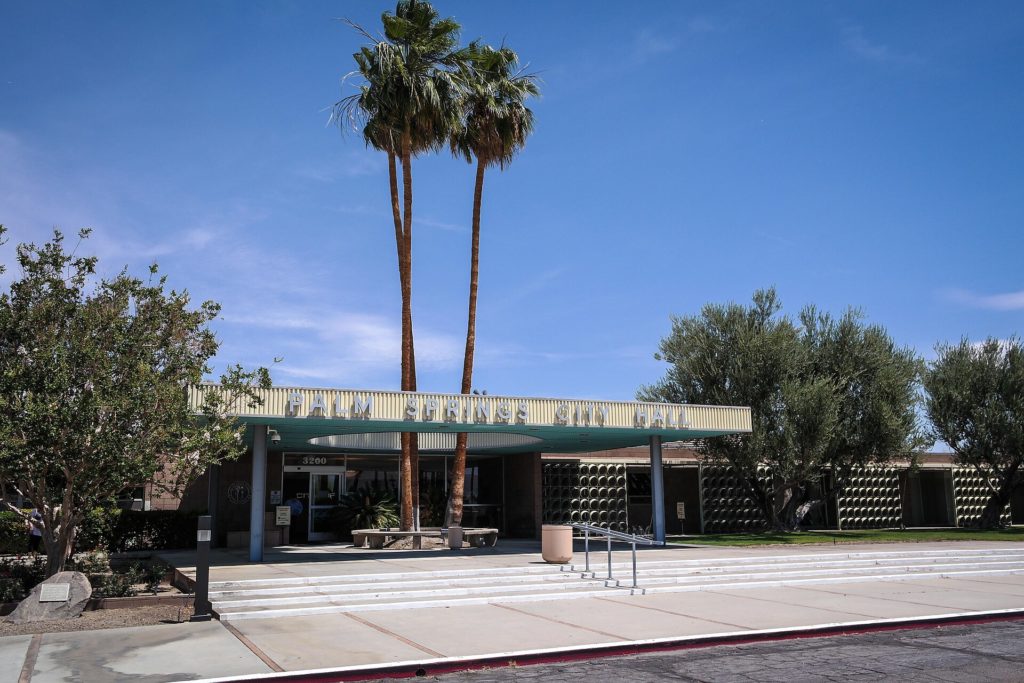
E. Stewart Williams also played a key role in establishing modernism in Palm Springs. Unlike Frey or Neutra, he developed a more practical approach that was directly linked to his clients. The house he designed for Frank Sinatra in 1947 marked a turning point: built for a Hollywood icon, it gave modernism new visibility and helped make it desirable. Williams uses a clear vocabulary defined by low lines, transparency, and a layout centred around the swimming pool, without seeking to be radical for the sake of ostentation. In his oeuvre, modernism was no longer avant-garde but simply a local fact of life, and something that could form an enduring bond with the landscape and its uses. The work of Donald Wexler, meanwhile, embodies a more experimental approach. Fascinated by the potential of industry, he explores the use of steel and prefabrication, notably in his famous series of Steel Development Houses. Through these projects, he seeks to make modernism reproducible and accessible, while simultaneously retaining a formal precision. Finally, John Lautner offers a more expressive take on the movement. Having previously worked with Frank Lloyd Wright, he developed a sculptural, sometimes spectacular architecture in Palm Springs, where the structures interact more freely with the landscape.
Together, these architects turned Palm Springs into a hotbed of innovation, combining European influences, Californian culture and post-war technological advances. What binds them together is the ability to conceive of architecture as an experience that is rooted in the surrounding landscape — sensitive to the climate, the terrain and the way the home will be used.
Today, the city still has one of the strongest concentrations of Mid-Century Modern buildings, and this heritage is not merely a feature of history: it continues to influence imaginations with its clean lines, transparency and light. In Palm Springs, modernism continues to define a way of living, and a specific idea of pleasure.


